
Process improvement is often discussed as a tactical exercise. In reality, it is a strategic discipline that determines whether a business can scale without breaking its operations.
Many companies adopt new tools, automation platforms, or frameworks prematurely. Without a solid understanding of process improvement methods, these initiatives often fail to deliver measurable results. This article provides a structured, expert-level overview of the most widely used business process improvement methodologies, explains their core differences, and outlines which approaches are most suitable for marketing agencies, law firms, and CPA firms.
Understanding Process Improvement in Modern Businesses

Process improvement refers to the systematic analysis and redesign of workflows to increase efficiency, reduce risk, improve quality, and support sustainable growth. Mature organizations treat process improvement as an ongoing management capability, not a one-time optimization project.
Effective process improvement initiatives typically address four core dimensions:
- Flow efficiency: how work moves across teams and systems
- Quality control: how errors and rework are prevented
- Standardization: how knowledge is documented and replicated
- Scalability: how output grows without proportional increases in cost or headcount
Different process improvement techniques emphasize different dimensions. Selecting the wrong methodology often leads to local optimization instead of systemic improvement.
Overview of Major Process Improvement Methods

1. Lean Methodology
Lean focuses on maximizing customer value by eliminating non-value-adding activities. Originating from manufacturing, Lean has been widely adapted to service-based and knowledge-driven businesses.
Lean defines waste as any activity that consumes resources without improving customer outcomes. Common forms of waste include waiting time, unnecessary approvals, redundant data entry, excessive handoffs, and rework.
When Lean is most effective:
- High-volume, repeatable workflows
- Service delivery environments with frequent bottlenecks
- Teams experiencing delays caused by manual coordination
Key process improvement tools used in Lean:
- Value stream mapping
- Standard operating procedures (SOPs)
- Visual workflow systems such as Kanban
2. Six Sigma
Six Sigma is a data-driven quality improvement method designed to reduce process variation and prevent defects. It is widely used in regulated and high-risk environments where errors carry financial, legal, or reputational consequences.
Six Sigma relies on the DMAIC framework: Define, Measure, Analyze, Improve, and Control. This structure ensures improvements are measurable, statistically validated, and sustained over time.
When Six Sigma is most effective:
- Accuracy and compliance are critical
- Errors are costly or irreversible
- Decisions must be supported by objective data
Common quality improvement methods within Six Sigma:
- Root cause analysis
- Process capability measurement
- Control mechanisms and audit trails
3. Lean Six Sigma
Lean Six Sigma combine Lean’s focus on flow efficiency with Six Sigma’s emphasis on quality and control. This hybrid approach addresses a common failure mode: improving speed at the expense of accuracy, or improving quality while slowing execution.
Lean Six Sigma is particularly effective in service organizations where processes are both time-sensitive and compliance-driven.
When Lean Six Sigma is most effective:
- Businesses scaling operationally
- Organizations facing both delays and errors
- Teams managing complex, cross-functional workflows
4. Kaizen and Continuous Improvement
Kaizen represents a philosophy of continuous, incremental improvement. Rather than relying on large transformation initiatives, Kaizen emphasizes frequent, small optimizations driven by employees closest to the work.
Continuous improvement frameworks such as PDCA (Plan, Do, Check, Act) institutionalize learning cycles, allowing teams to test changes, evaluate outcomes, and refine processes iteratively.
When Kaizen is most effective:
- Organizations with stable core processes
- Leadership seeking long-term operational excellence
- Cultures that value employee-driven improvement
5. Entrepreneurial Operating System (EOS)
EOS is not a traditional process improvement technique. Instead, it is an operating framework designed to align strategy, people, processes, and execution.
EOS addresses a common organizational problem: processes exist, but they are inconsistently followed due to lack of clarity, accountability, or measurement.
EOS is most effective when:
- Leadership alignment is weak
- Core processes are undocumented or ignored
- Execution discipline is the primary constraint
EOS strengthens process improvement efforts by embedding them within governance, accountability, and performance management structures.
6. Project Management Office (PMO)
A Project Management Office centralizes project governance, methodologies, and reporting. While not a process improvement method by itself, a PMO enables consistent execution across complex, project-driven environments.
PMOs reduce variability in delivery by enforcing standards, improving resource allocation, and aligning initiatives with strategic priorities.
PMOs are most effective when:
- Work is predominantly project-based
- Multiple initiatives run concurrently
- Coordination and visibility are major challenges
Comparing Process Improvement Methods
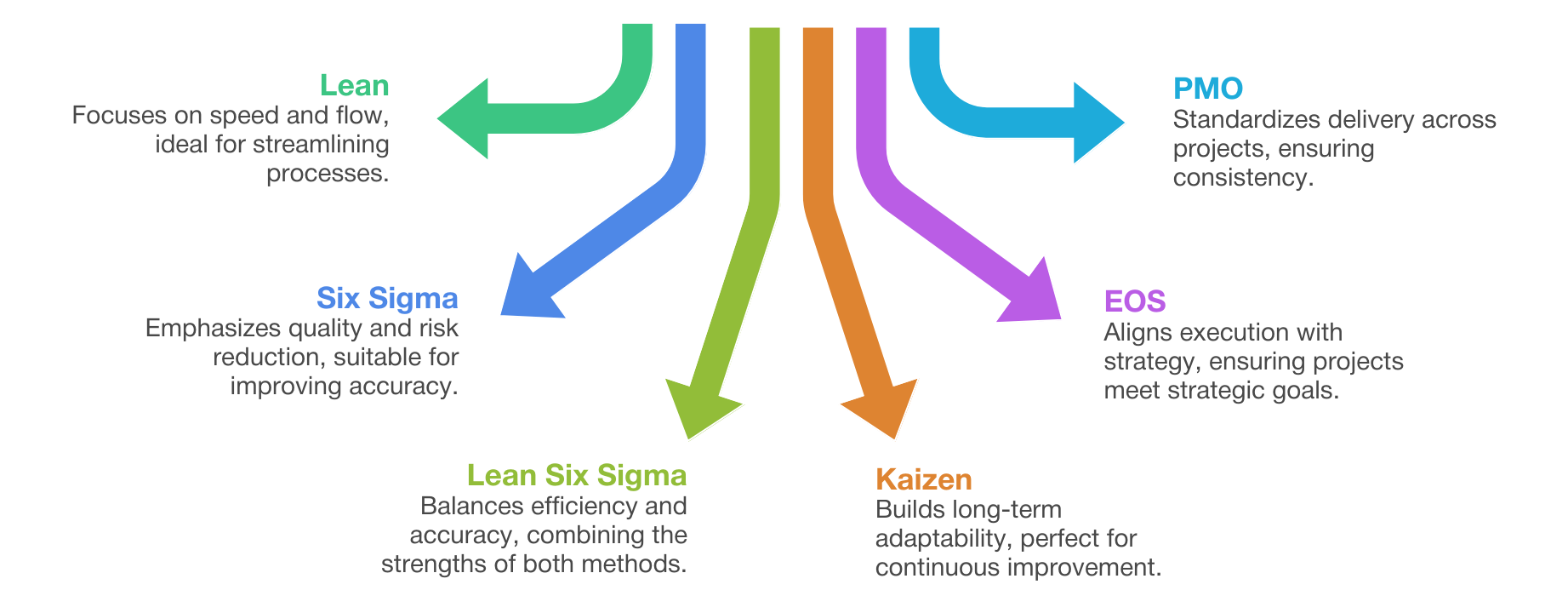
Each methodology optimizes a different dimension of performance:
- Lean prioritizes speed and flow
- Six Sigma prioritizes quality and risk reduction
- Lean Six Sigma balances efficiency and accuracy
- Kaizen builds long-term adaptability
- EOS aligns execution with strategy
- PMO standardizes delivery across projects
Expert practitioners often combine multiple approaches rather than relying on a single framework.
Common Misapplications of Process Improvement Methods
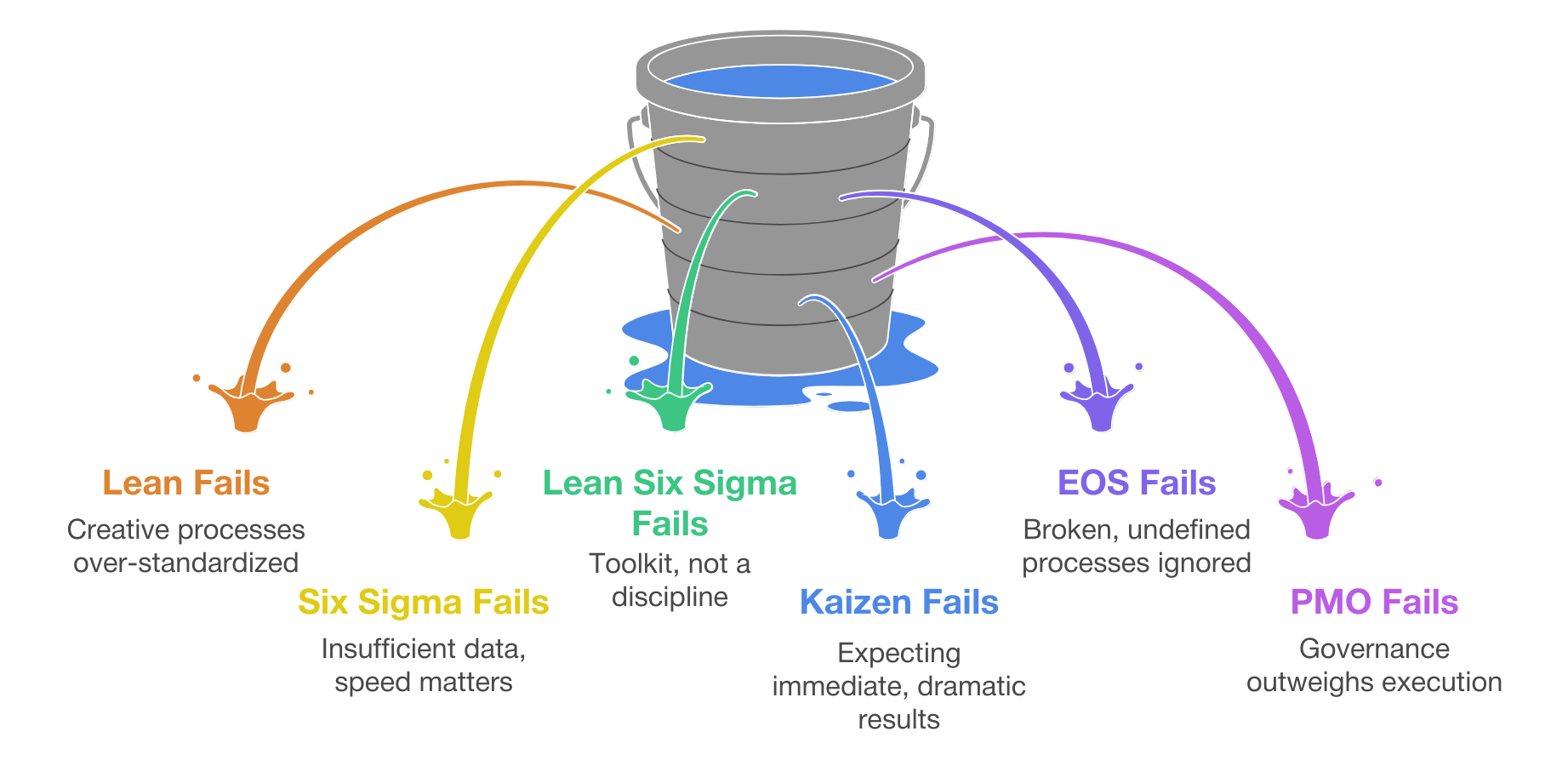
Even well-established process improvement methods fail when applied in the wrong context.
- Lean fails when processes are highly creative, non-repeatable, or constantly changing. Attempting to over-standardize creative or exploratory work often slows teams down instead of improving outcomes.
- Six Sigma fails when organizations lack sufficient data maturity or when speed matters more than statistical precision. In early-stage or fast-moving teams, Six Sigma can become excessive and bureaucratic.
- Lean Six Sigma fails when leadership treats it as a toolkit rather than a discipline. Without ownership and follow-through, hybrid initiatives collapse into fragmented improvements.
- Kaizen fails when leadership expects immediate, dramatic results. Continuous improvement compounds over time and cannot replace fundamental process redesign.
- EOS fails when broken or undefined processes are ignored. EOS enforces discipline, but it does not automatically fix inefficient workflows.
- PMO fails when governance outweighs execution. Overly rigid PMOs often create approval bottlenecks and slow decision-making.
Expert practitioners recognize that no methodology compensates for poor diagnosis.
Selecting the Right Process Improvement Method by Business Type

Marketing Agencies
Marketing agencies operate in fast-paced, client-facing environments where speed, consistency, and coordination are critical.
Common operational constraints:
- Inefficient client onboarding
- Inconsistent campaign execution
- Manual reporting and follow-ups
- Bottlenecks between sales, delivery, and account management
Most effective approaches:
- Lean to eliminate delays and handoffs
- Lean Six Sigma to standardize delivery quality
- EOS to align teams around documented core workflows
Law Firms
Law firms operate in high-risk, knowledge-intensive environments where errors have significant consequences.
Common operational constraints:
- Compliance and regulatory exposure
- Heavy documentation requirements
- Knowledge silos across attorneys and teams
Most effective approaches:
- Six Sigma for accuracy and error reduction
- Lean Six Sigma to improve turnaround time without increasing risk
- PMO structures to manage complex cases and deadlines
CPA Firms
CPA firms face extreme workload variability, particularly during tax seasons, while operating under strict regulatory requirements.
Common operational constraints:
- Manual data reconciliation
- Seasonal capacity bottlenecks
- Compliance-driven rework
Most effective approaches:
- Lean to reduce manual effort
- Six Sigma for audit and reporting accuracy
- Lean Six Sigma combined with automation to scale without hiring
Conclusion: Process Improvement as a Strategic Capability
There is no universally superior process improvement method. The effectiveness of any approach depends on business model, risk tolerance, operational maturity, and leadership discipline.
Organizations that scale successfully do not ask, “Which methodology is best?” Instead, they ask, “Where is our constraint, and what discipline best addresses it?”
In practice, high-performing businesses combine multiple process improvement methods and reinforce them with automation, measurement, and accountability. Structured methodologies create clarity. Automation enforces consistency. Together, they transform operations from manual effort into resilient, scalable systems.